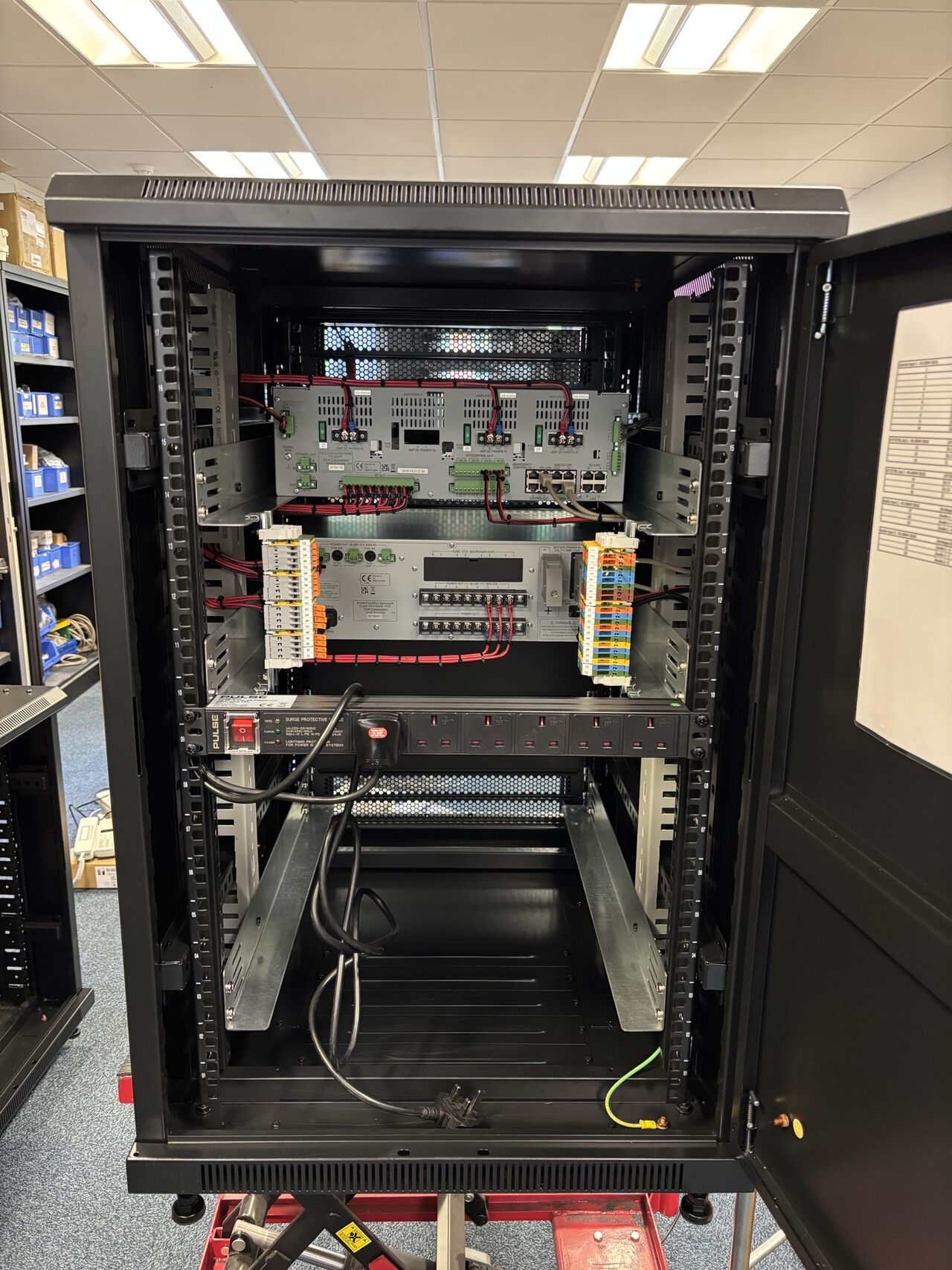
What an emergency voice alarm system is
An emergency voice alarm system plays spoken messages through speakers in a building when there is a fire or another emergency. A siren only says that something is wrong. A spoken message can say what to do: which stairs to use, which exit is clear, and when to stay put.
The system is built to keep working during the emergency. It has its own power backup, it monitors its speaker lines and amplifiers for faults, and it takes priority over music, paging and everyday announcements.
Why spoken instructions work better
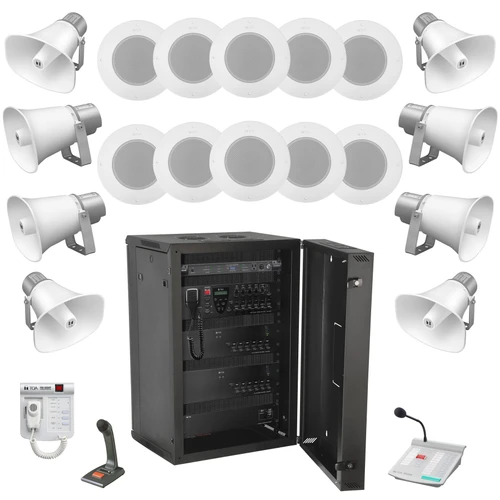
Research going back to the 1980s found that many people do not react to a bell. In one study, 13% of people reacted in a timely way to a bell, while 75% responded to a voice giving evacuation instructions. More recent research with children found that more than 90% woke to a voice message, compared with just over 53% for a conventional alarm.
These are small studies, and results depend on the building and the people in it. The point holds across them: a clear message gives people something to act on.
Emergency voice alarm and public address
Public address is for everyday use: announcements, paging, background music and messages to staff. An emergency voice alarm must meet a recognised standard, and it has to work when the building is in an emergency. Many manufacturers now build both into one system, so the same speakers and amplifiers serve daily announcements and emergency messages. TOA’s VM-3000 and VX-3000 series are examples of this.
The emergency functions run on certified control equipment. Daily PA runs on the same hardware but is switched off, overridden or muted when the emergency function takes over.
How it works, step by step
Open each step below to see what happens.
1. The fire alarm detects a fire
Smoke or heat detectors and manual call points feed the fire alarm control panel. The panel decides that an alarm condition exists and sends a signal to the voice alarm system.
2. The controller chooses the message and zones
The voice alarm controller selects a pre-recorded message or switches to a live microphone. It decides which zones receive the message, usually the floor on fire first, then the floors above and below.
3. Amplifiers drive the speaker lines
The amplifiers send the message to the selected speaker lines. A standby amplifier or a second amplifier path keeps the message going if one channel fails.
4. Speakers play the message
Speakers in each zone play the message at a level the design has checked. Speech clarity is measured in the building, not assumed.
5. The system reports faults
Fault monitoring tells the building team when a speaker line, amplifier or power supply needs attention. Operators can see the state of each zone.
Multi-zone amplifiers
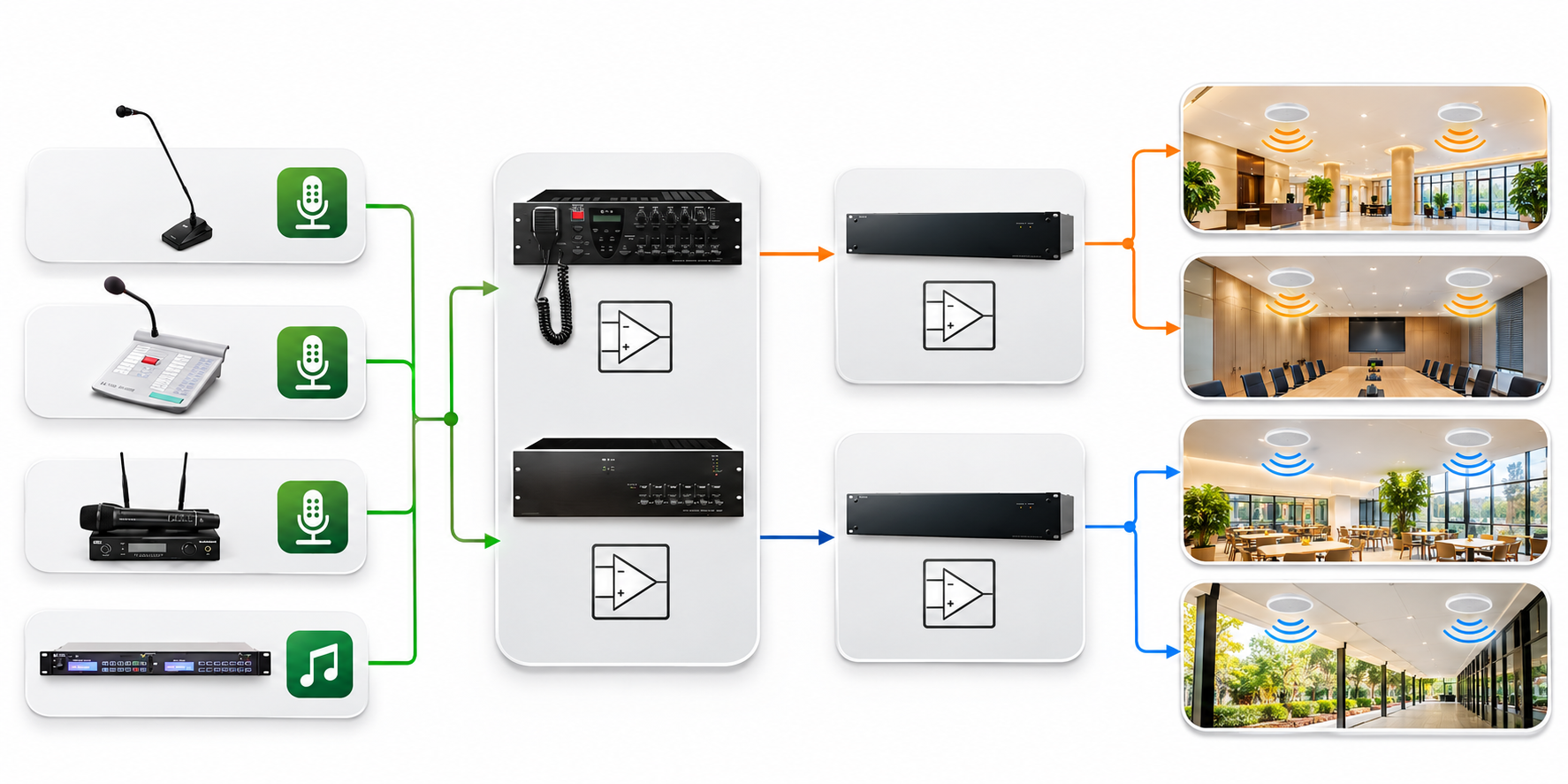
A multi-zone amplifier sends different audio to different parts of a building. In an emergency, the message can go to the affected floor only, or to the whole building. The rest of the building can stay quiet, so the message stays clear where it matters.
The TOA VM-3360VA has a rated output of 360 W in total across six zones. TOA’s VX-3000 frames come with 4, 8 or 16 speaker outputs (VX-3004F, VX-3008F and VX-3016F). The VX-3008F can switch its eight zones between two amplifiers, so two different audio signals can run at the same time.
Ground floor lobby
Ground floor corridor
Car park
Stairwell A
Upper floors
Stairwell B
Fire alarm integration
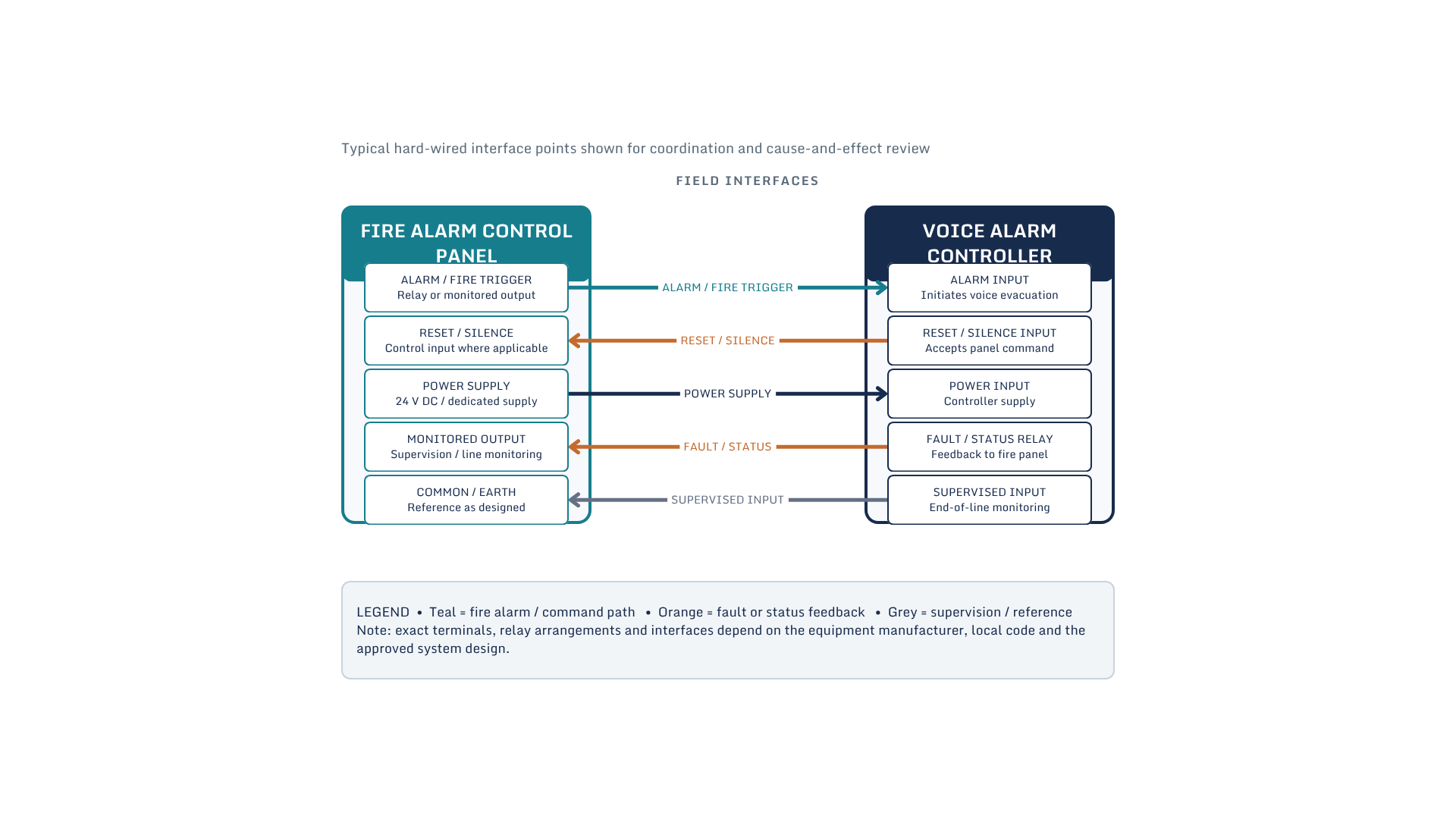
The voice alarm system works with the fire alarm system. The fire alarm finds the fire and triggers the voice alarm. The voice alarm plays the right message to the right zones and reports its own faults back.
EN 54-16 covers the functions a voice alarm controller must have. These include a voice alarm condition output, indication of faults related to voice alarm zones, manual control, an interface to external control devices, and emergency microphones. The standard does not fix how many fire panel interfaces a system must have, so the integration is planned for each building.
Standards: EN 54 for Europe and UL for the US
A voice alarm system is approved against different standards depending on the market. Check which one your fire authority and insurer accept before you specify the equipment.

Europe, and the UK and many other markets that follow EN 54. Parts that matter for voice alarm: EN 54-16 (controller and amplifier), EN 54-4 (power supply), EN 54-24 (loudspeakers), EN 54-17 (short-circuit isolators) and EN 54-2 (fire control panel).

United States. UL 2572 covers mass notification equipment, and NFPA 72 is the code that uses it. UL 1480 covers speakers used for fire and emergency purposes. Canada uses CAN/ULC-S576.
EN 54-16 covers the control equipment and its functions. It does not set the speech intelligibility target for a building. In practice, intelligibility is checked against IEC 60268-16 (STI or STIPA) and a national code of practice. In the UK, BS 5839-8:2023 is the code of practice for voice alarm design, installation, commissioning and maintenance. Some sources quote an STI of 0.50 as the minimum for emergency messages. Confirm the target that applies to your project with the designer.
For the US, TOA lists UL 2572 and CAN/ULC-S576 for specific VM-3000 models, and it notes that output is reduced for the UL configuration (200 W for the VM-3240VA). The VX-3000 is listed as EN 54-16 certified, and we have not confirmed a UL 2572 listing for it. We will confirm before publishing any US claim for a specific product.
Systems for small, medium and large buildings
Emergency voice alarm systems come in different sizes, and the right one depends on the building. The two TOA families below cover small to medium sites and large sites. The model names are given for reference.
VM-3000 series
An integrated voice alarm and public address system for small and medium sites. TOA lists schools, shopping centres and restaurants among its typical applications. The VM-3240VA is a 240 W amplifier and the VM-3360VA a 360 W amplifier, both 6 zones, 230 V AC power, rack-mounted. Remote microphones such as the RM-200M and the fireman’s microphone RM-300MF connect to the system. Expansion amplifiers (VM-3240E and VM-3360E) add more zones.
VX-3000 series
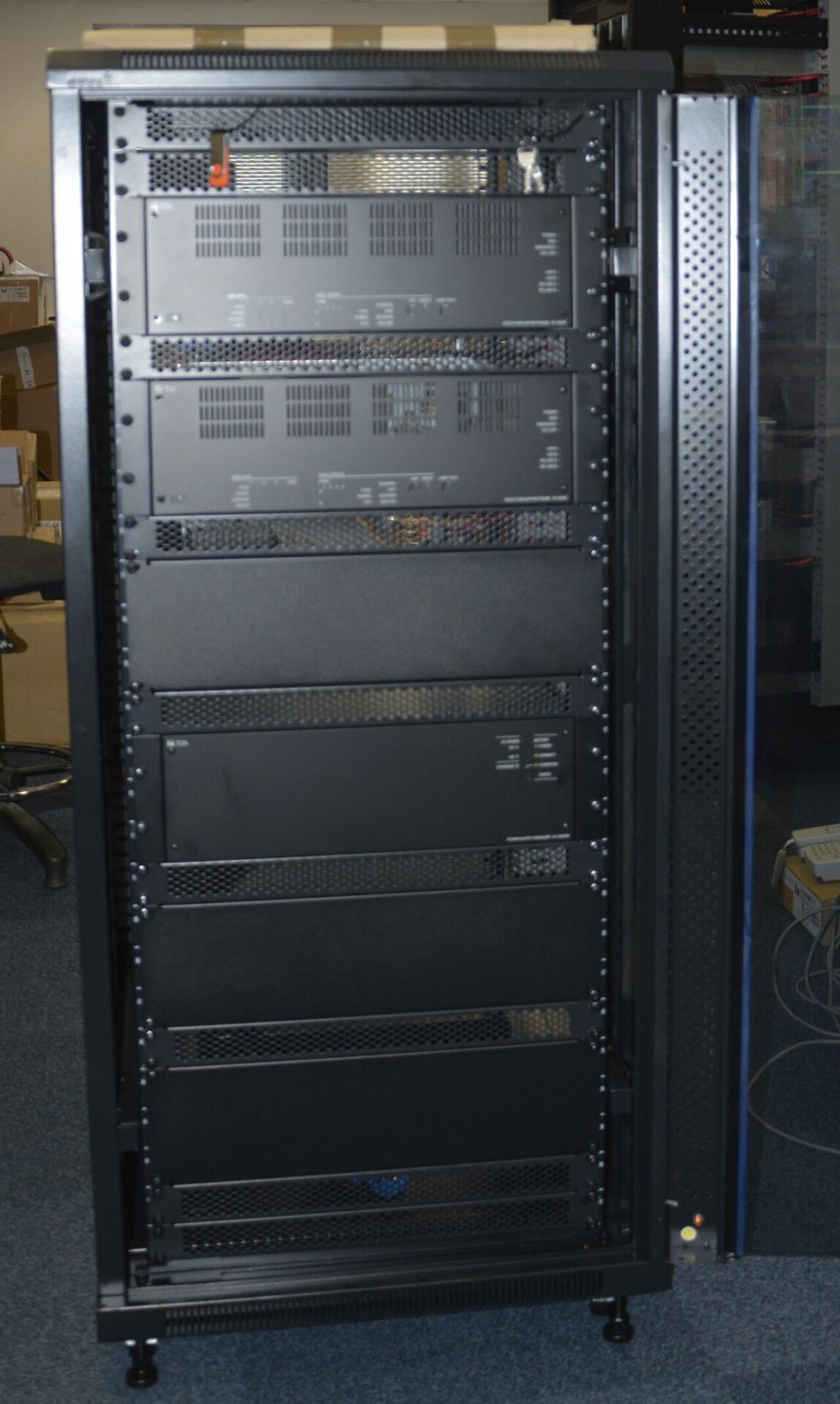
A rack-mount voice alarm and public address system for larger sites. It is built from a frame (VX-3004F, VX-3008F or VX-3016F), with extra modules for power, control and network connections. TOA states the system can scale to 1280 remote microphones and 2560 speaker lines in large configurations. It can be controlled by external devices and supports Modbus, and it has a redundant LAN option for more reliable networking.
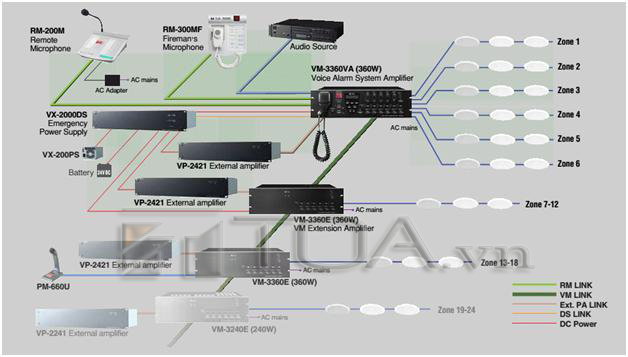
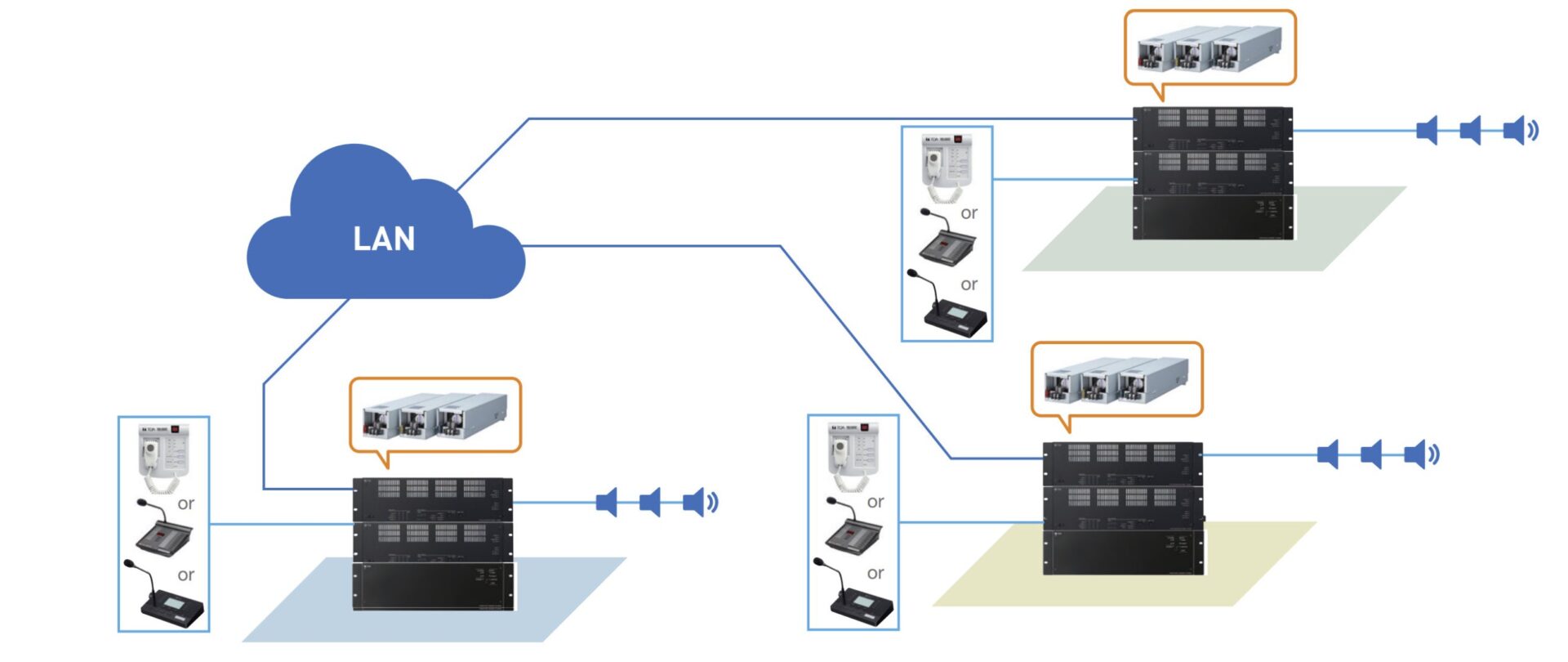
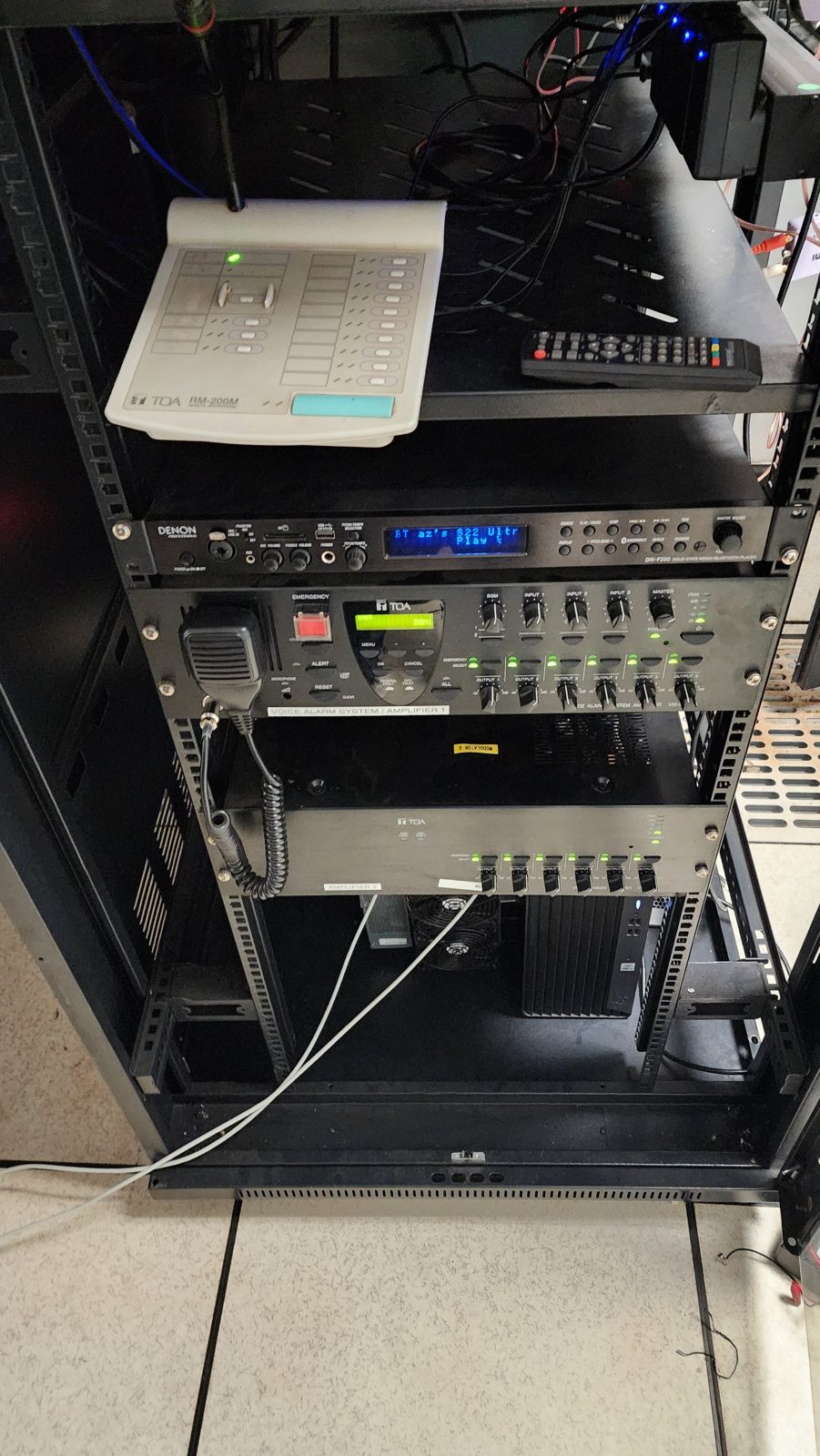
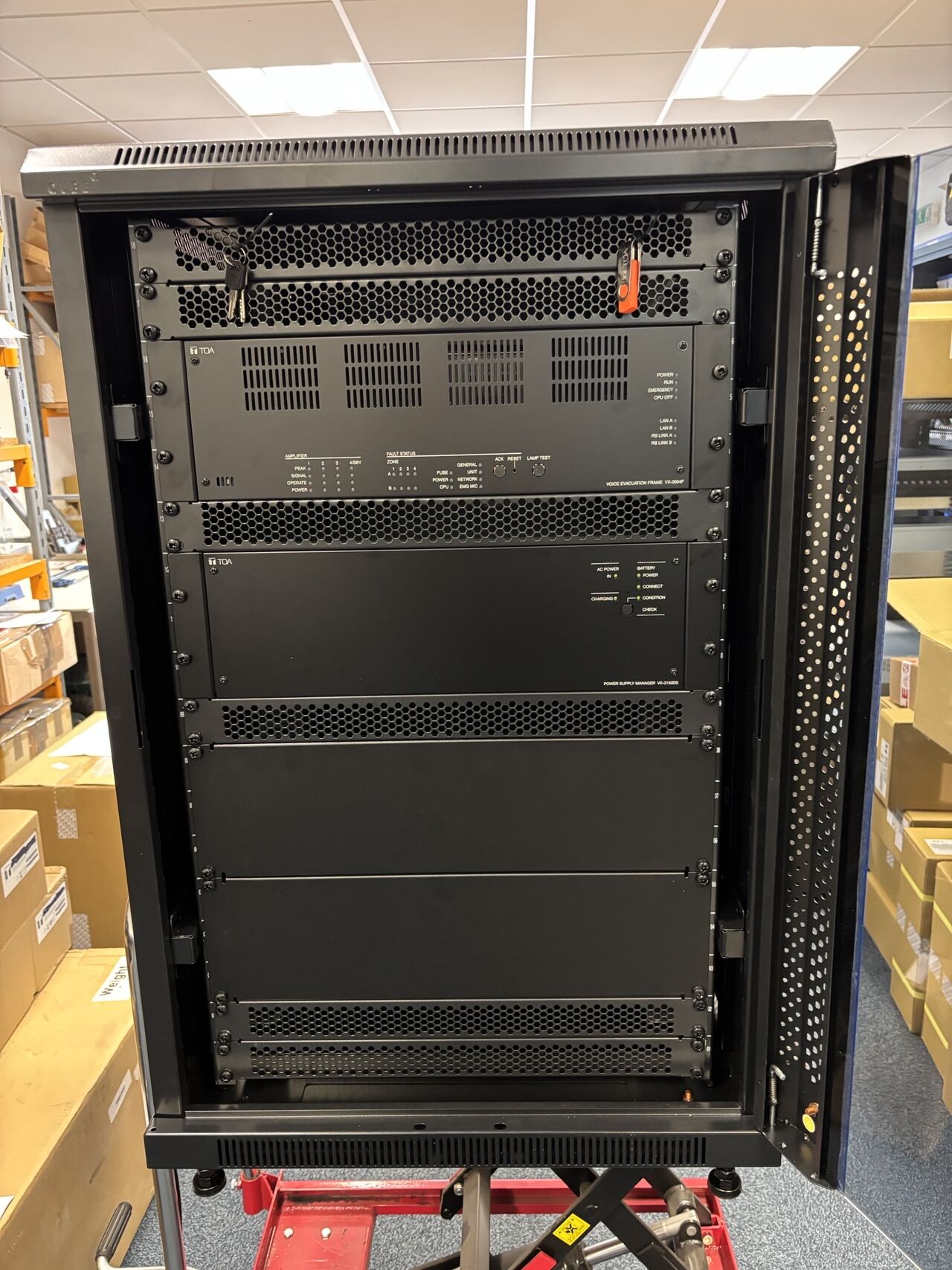
Choose the series during design, based on the number of zones, the size of the building and the level of control needed. Check the exact model number and its certificates before quoting.
How the systems compare
Use this table to see which type of system fits your building. The four columns cover the two TOA emergency families, networked PA and standard multi-zone PA.
| Integrated PA and voice alarm, small to medium | Integrated PA and voice alarm, large sites | IP network PA | Multi-zone PA (general paging) | |
|---|---|---|---|---|
| Typical buildings | Schools, shopping centres, restaurants, fitness clubs | Airports, railway stations, shopping malls, concert halls, stadiums, factories | Sites where audio runs over the building network, with browser control | Offices, schools and shops for announcements and background music |
| Emergency voice alarm | Certified to EN 54-16. UL 2572 on selected models. | Certified to EN 54-16. Check the UL position for your model. | Only if the exact model carries the certificate. Check before specifying. | Not certified for emergency use. Not a substitute for a voice alarm system. |
| Zones | 6 per amplifier. Expandable with extension amplifiers to a larger total. | Built from frames with 4, 8 or 16 speaker outputs. Scales up with more frames. | Set by the network and audio interfaces in the design. | Set by the amplifier and the wiring to each zone. |
| Remote microphones | Up to 8, of which up to 4 can be emergency microphones. | Large configurations support many more remote microphones. Check the datasheet for your system size. | IP microphones connect directly to the network. | Depends on the mixer or paging panel. |
| Control and networking | Front panel controls and PC configuration software. | Remote control protocols, Modbus and an optional redundant LAN. | Browser-based control, monitoring and setting. | Local panel or simple controller. |
| Best for | One compact system for everyday PA and emergency messages in a smaller building. | Large or complex sites that need many zones, remote microphones and networking. | Multi-site or networked audio that needs central browser control. | Everyday announcements and music where no emergency function is required. |
Specifications vary by model and configuration. Check the datasheet and certificate for the exact product before you quote.
Why install an emergency voice alarm
In a large building, people may not know where the fire is, which exit is safe, or whether the alarm is real. A spoken message gives them a clear next step.
Requirements depend on the building, the number of people in it and local rules. Confirm them with your fire authority, insurer and designer before the specification is final.
Clear next steps
A spoken message tells people which stairs to use, which exit is clear and when to stay put.
Zoned response
Warn the affected floor first, guide people away from it and keep other areas calm.
Faults found early
Fault monitoring tells the building team about a problem before an emergency, not during one.
Where to install it
Emergency voice alarm is normally planned for buildings where many people gather or sleep, or where people may need time to leave.
Speakers are placed so the message is clear in every part of each zone. Speech clarity matters as much as volume: a loud message nobody can understand does not help.
Design, cabling and commissioning
The design decides how many zones are needed, where each speaker goes, how loud the message must be, and how the controller connects to the fire panel. It also covers power backup and the cable route for each speaker line.
Design
Zones, speaker positions, loudness and the link to the fire panel.
Cabling
Fire-resistant speaker and control cables, routed as the design specifies.
Installation
Fitted by our trained resellers and system integrators.
Commissioning
Each zone checked for coverage, speech clarity and fault response.
Speaker and control cables must be routed as the design specifies and kept apart from mains wiring. Cable choice and routes should not change on site without the designer’s approval.
Training
Operators and installers need to know the controller, the zones and the fault indicators before the system goes live. PRO AV Africa’s team is trained and certified on TOA equipment.
TOA Africa Online Training Center
Sign up for the TOA Africa online courses and learn at your own pace.
Who designs and installs it
PRO AV Africa is a value-added distributor. We supply the equipment, design the system, train our partners and commission the finished installation. We do not carry out installations ourselves.
PRO AV Africa
Supplies the equipment, designs the system, trains our partners and commissions the finished system.
Our trained installers
Resellers and system integrators install the system to the approved design.
You
Send us your plans, floor count, zones and fire panel details. We help you choose the series and connect you with a trained installer.
Email [email protected] or call +256 (0) 752 50 60 90.